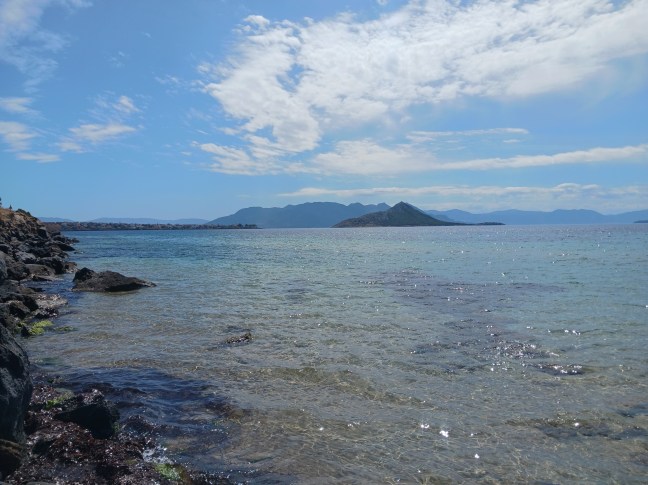
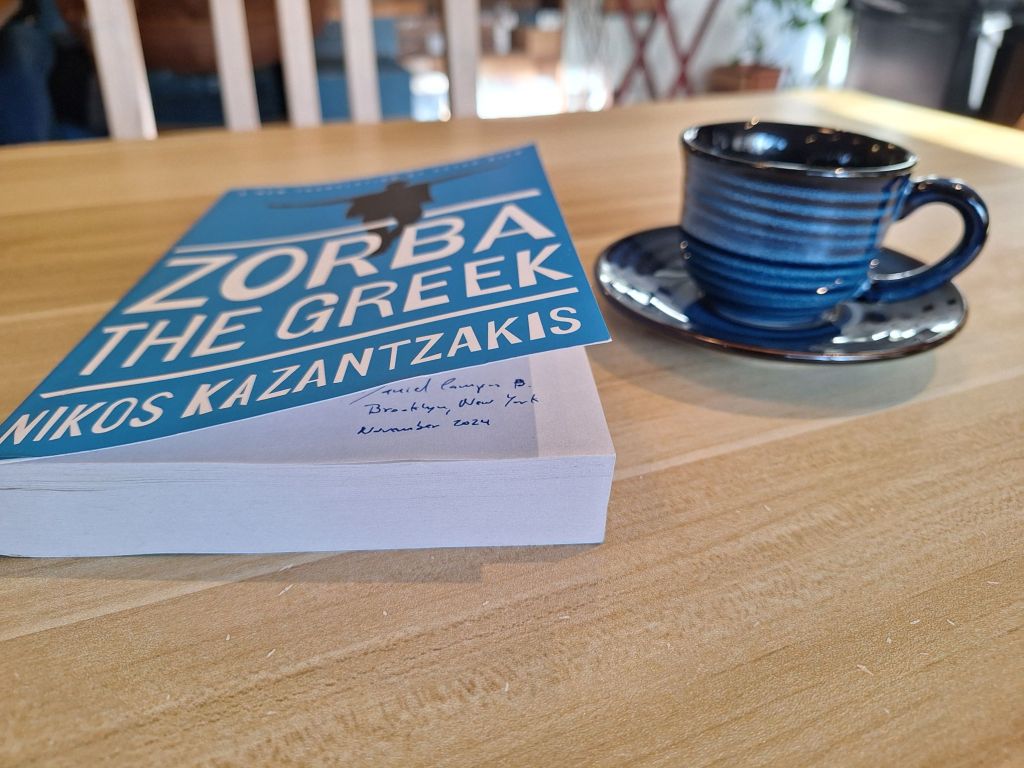
This has been a remarkably Greek year for me. I have been able to read quite a lot of Ancient Greek philosophy and literature, and I have engaged in conversation with contemporary commentaries on those traditions. I traveled to Athens in April and came back to the Americas with a desire to return to Hellas and travel in the mainland, along the coasts, and to the islands. And I was able to read some modern literature: The Complete Poems of C.P. Cavafy, Collected Poems of George Seferis, and now Zorba the Greek, the picaresque novel by Nikos Kazantzakis.
There’s much to say about all of it, but in recent days Zorba has been my main company. The classical theme of the Apollonian and Dionysian impulses in human life comes alive in Kazantzakis’s gem. The eponymous character of the novel personifies the Dionysian pulse in humanity–that which is passionate, sensuous, impulsive, emotive. Meanwhile the narrator, Zorba’s “Boss,” embodies the Apollonian in us–that which is measured, intellectual, balanced–even if, strangely, the Boss regards himself as Buddhist.
There is a scene, early in the novel, that portrays this contrast well. Zorba confesses that in the presence of women or of the sea, he cannot analyze, calculate, ponder anything related to work, mines, or engineering. The Boss teases him: “It’s your own fault. You lack the strength to keep your mind in check.” But Zorba’s reply is remarkable:
Look, I was passing through a small village one day. An old fogety ninety years old was planting an almond tree. ‘Hey, Grandpa,’ I say to him, ‘are you really planting an almond tree?’ And he, all bent over as he was , he turns and says to me, ‘My boy, I act as though I am never going to die.’ I answered him in my turn, ‘I act as though I’m going to die at any moment.’ Which of the two of us was right, Boss? (44)
The Boss in unable to answer. He is thirty-five and has lived an over-intellectualized life of self-restraint, verging on asceticism (this is what he strangely calls Buddhism). He desires a young widow in a small village in Crete but regards his desires as sinful. Yet he admires Zorba’s zest and force. At sixty-five, Zorba has no doubts or qualms as to his Dionysian principle of vital philosophy:
Women and wine galore, sea and work galore! Full blast no matter what! Work on full blast. Wine, sex, all on full blast. No fear of God; no fear of the Devil. (262)
The experiential, philosophical crux of the novel is not whether Zorba will temper his impulses to become more balanced –he will not!–, but whether the Boss will liberate at least some of his Dionysian desires, live them out, and enjoy them as thoroughly as Zorba enjoys drinking, eating, working, dancing, scheming, and erotizing. And if so, will the Boss sustain the Apollonian-Dionysian equilibrium, or will he go back, in repentance, to his pseudo-asceticism but with nostalgia, and powerless admiration, for Zorba’s zest and vitality?
And all of this, of course, is not an exercise in literary criticism for me. The question is about philosophy as a way of life. Who was right: the venerable Apollonian man planting the almond tree in his orchard, or Zorba, the ever-wandering Dionysian? Is the dilemma false? The stakes are not intellectual, but rather experiential and vital.
 Daniel G. Campos
Much food for thought, as always.
LikeLiked by 1 person
Here’s to thinking together!
LikeLike